
What is Drum Flaker and how does it work?
Drum Flaker machine is used to dry solutions or convert molten materials into solid state. During a crystallization or solidification process, state transformation takes place.
The molten or soluble feed is placed in contact with a rotating drum, which is cooled or heated by the internal fluid according to the desired operation.
If the purpose of the operation is to dry the solution; For the internal fluid, a warm fluid such as steam, hot water and hot oil is chosen, and in cases where the goal is to convert molten materials into a solid state; A cold fluid such as water, glycol, etc., is selected as the internal fluid of the drum.
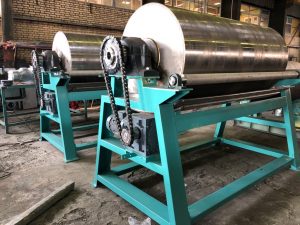
In this way, with the rotation of the drum, heat is transferred and the desired product is separated from the surface of the drum in a solid form by a knife or a blade made of cast iron, chrome-steel, copper-beryllium, etc.
The dimensions, form and size of the product depend on factors such as the type of feed as well as the process conditions. In addition, it is possible to control the size of the product by adjusting the rotation speed, layer thickness and blade angle.
According to the type of material used, the flicker drum is made of different materials such as nickel alloys, carbon-steel, stainless steel and even bronze.
Also, it is better to know that the design, implementation and construction of drum flickers are generally done according to BS or ASME standards and their size is also determined based on thermal load.
Drum Flaker applications in industries
Drum Flaker are used in various industries, the most important of which are food, chemical and health industries. The use of Drum Flaker in the mentioned industries includes the production of the following materials:
-
- chemical industry: Materials such as fatty acids, calcium chloride, polyethylene glycol, resins, etc.
- Food industry: Ingredients such as cheese, vegetables, chocolate, dough, etc.
- hygiene industry: Materials such as soap
As we said above, the Drum Flaker is primarily used for the production of chemical and pharmaceutical products. However, more applications for this type of machinery are also found in the food industry.
This machine, i.e. Drum Flaker, has been developed for a wide range of other applications, which we will mention some of them below:
- Textile Industry
- Pharmaceutical industry
- Food products
- chemical industry
- Paper industry
- Pigments
- Starch products
- Pesticides and fertilizers
- Adhesive industry
and many other uses of drying
In addition, since it is possible to design the Drum Flaker as a closed and enclosed system, this machine is also used for toxic or strong-smelling materials.

Benefits of Drum Flaker
Some of the benefits of Drum Flaker are listed below:
-
-
- It is used in a wide range of chemicals and pharmaceuticals.
- Drying and cooling operations in this machine are done continuously.
- It is easy to use and has a low operating cost.
- It has high thermal efficiency and minimal thermal degradation.
- Drum speed is adjustable for optimal performance.
- With the help of the Drum Flaker, relatively large solids can be made in just one step.
- It is possible to produce products with uniform size.
-
Drum Flaker components
-
-
- cutter
- Drive
- hitters
- chassis
- Cooling drum
- Auxiliary mechanisms
- Electrical panel and control devices
- Cover and isolation system
-
In the following figure, the overview of a Drum Flaker is displayed:
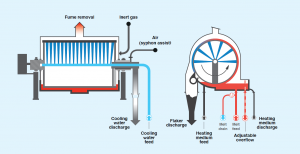
according to the type and temperature of the molten material entering the device (or in other words, corrosion considerations) and the rules and standards that are common in each trade; The material of the drum and the parts in contact with the molten material are selected.
The dimensions and size of the drum are also calculated and determined according to the production capacity and the temperature difference between the melt and the cold water. Choosing the correct ratio of length to diameter is very important in determining the size and dimensions of the drum and has a great impact on the useful life of the drum and preventing its complications.
Types of flickers have two characteristics: Mechanical capacity and thermal capacity, which these two characteristics are calculated in the following way:
Mechanical capacity = number of revolutions of the drum x its density x film thickness x drum surface
Heat capacity = latent heat absorbed during freezing at the melting point + heat absorbed from the inlet temperature to the crack
In standard flickers, the thermal capacity corresponds to the mechanical capacity. If in some cases, the heat capacity is smaller and less, the material before reaching the separation temperature or in other words, take off; They engage with the blade and make it paste (in a wrinkled form).
Larger and higher heat capacity can also lead to material boiling in the drum and frequent blade slowing down. As a result, in a short period of time, the blades need to be replaced, which increases costs.
Flickers feeding
In terms of feeding, flickers are divided into 4 categories:
1- Deep feed
2- Top feed (roller)
3- twins
4- and special cases
The figure below shows the types of feeding, i.e. pan, roller and twin:

For each type of material, according to its behavior and chemical and physical characteristics, one of the types shown in the picture above; It is suitable and ideal. Due to the sensitive and specialized nature of Flicker type selection, if the employer does not have a definite and precise opinion, the selection of the appropriate type for the material will be done by experts at the stage after obtaining the material sample.
Flickr drum selection and design
In the selection and design of the flicker drum, the following detailed information is needed, and this information must be provided to the designer.
The most important information required:
-
-
- The most important information required:
- The degree of acidity or alkalinity of the solution
- Production method (cooling or heating)
- capacity
-
drumflaker cooling methods
There are three methods for the drum cooling process:
1- The whole length of the drum is filled with cold water.
2- By placing an inner shell, a cold water jacket is created.
3- The water is uniformly sprayed on the inner surface of the drum by means of internal nozzles, and after creating a turbulent layer and absorbing heat, it reaches the bottom of the drum and exits.
The first and second methods, i.e. water filling or two-shell drum, are no longer common among the public due to low thermal efficiency and the possibility of the drum cracking problem.
The spray nozzle method currently used by reputable European manufacturers has the highest thermal efficiency and the lowest cold water consumption.
For this reason, in order to achieve a certain production capacity, we need a smaller cooling tower or chiller, which can be very effective in the required costs.
Familiarity with material separation system (blade or cutter) in Flickr drum
Another important and effective issue in Flickr performance is the material separation system (cutter or blade). In the past, a fixed blade with bean-shaped holes on it was sufficient.
Over time, manufacturers and consumers found that these fixed cutters, in addition to the many problems they had in the initial setting, after a short period of time, became slow and their settings were messed up.
Companies that have the necessary standards; In their devices, they use RO type blades that have three degrees of freedom. This cutter system is the newest separation method currently used by reputable European manufacturers.
One of the most important features of these blades is easy rigging, very low wear and tear, and the ability to control the size of the product. These types of cutters can shred the solid film from very small size (the size of coconut powder) to large size (flake flakes).
Due to the fierce competition in the chemical market, the ability to control the size of the shredding can be a useful tool in attracting the attention of buyers.
Currently and in today’s world, the safety of operators and the pollution of factory space cannot be ignored. This becomes a necessity for filling materials that have toxic or flammable vapors.
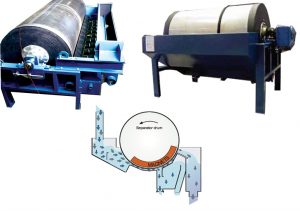
How to design and build a drumflaker
Other things that companies with standards observe in the design and construction of their flicker drums; Below is the list:
-
- De-stressing the drum before machining; This is necessary to maintain the dimensional accuracy of the drum in the long term.
- Using electrical or mechanical heaters (steam or oil) to keep the feed system warm, which protects the melt movement and distribution paths from freezing and clogging.
- Using correct and precise methods in making parts (especially drums) based on past experiences. If the required accuracy is not established in the manufacture of drums and cutters, adjusting the cutter or blade on the drum will be very difficult and in some cases impossible. If the connection methods and welding order of the parts are not followed, the accuracies obtained will be lost with the passage of time due to the tilting of the parts.
- The use of (2+5) stage seals in the cold water inlet and outlet, which completely seals these connections and will not leak water with continuous and long-term operation.
- Using raw materials and quality parts (reputable brands) in the process of making the device
- Providing facilities and auxiliary mechanisms on the device for ease of operation and repairs
- The possibility of adjusting the thickness of the solid film in all types of devices
- The possibility of designing and manufacturing flickers in the highest protection class (EXd) for highly toxic or flammable materials