
What is nickel?
Nickel is the 28th element of the periodic table and the fifth most common element on the planet, which is readily found in the earth’s crust and core. This metal element that has a shiny and silver appearance; Along with iron, it is one of the common elements in meteorites and can even be seen in small amounts in animals, plants and sea water.
Although the concentration of this age is 80 parts per million; However, the earth’s core is basically composed of nickel and iron alloy.

Nickel alloy belongs to the group of iron and cobalt elements and in terms of magnetic properties and chemical activity, it is similar to these two elements. Nickel alloy because of its great resistance to weather; It does not oxidize, and due to this, it is useful for the production of coins, iron and brass metalwork, as well as for the manufacture of chemical tools in special alloys such as German silver.
Physical and chemical properties of nickel
The nickel element has extraordinary physical and chemical properties that have caused these properties; Nickel plays an essential role in hundreds of thousands of products. The most common use of this element is in alloys, especially with chromium and other metals, to produce heat-resistant and rust-resistant steels.
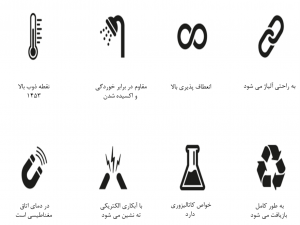
You can see its main features in the following table:
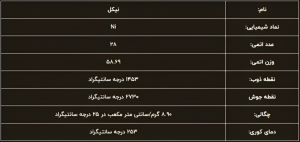
Properties and characteristics of nickel
**** This metal has the following important features:
Nickel has excellent mechanical properties and shows excellent resistance in reaction with corrosive environments.
When nickel is used at high temperatures, it will be able to maintain itself well, and in other words, it has good strength.
Nickel will have properties such as ductility and toughness at low temperature.
Some metals have extraordinary hardness, and nickel, like steel, has this ability. In addition, nickel will easily combine with sulfur.
The non-oxidization of nickel in air and water is another property of this metal.
Many valuable alloys are produced from nickel, which may be useful in various industries.
The purity of nickel is 99%.
There is a percentage of carbon in nickel, which is a little more than one tenth of a percent. It is clear that the lower the amount of carbon, the harder nickel is.
Nickel is found in two forms, metal and soluble.
Nickel has suitable features that can be used in all industries.
The most use of nickel will be for the production of stainless steel tools.
There are different alloys of nickel, including Monel alloy (copper-nickel), cream-nickel alloy, and others.
About 69% of the nickel element is used to make stainless steels and the remaining 15% is used in other steel and non-ferrous alloys.
Often for highly specialized industrial, aerospace and military applications; About 8% is used in electroplating and 3% in casting and casting, about 3% is used in batteries used in electronic components and in batteries used in portable equipment and hybrid vehicles, and approximately 2% is used in chemicals. , dyestuff and catalyst are assigned.
Nickel alloys
Nickel is easily alloyed with a large number of metals such as chromium, copper, iron and molybdenum. Adding it to other metals changes the properties of the resulting alloy, and they can be used to provide desired properties such as improved corrosion or oxidation resistance, increased thermal efficiency, or reduced coefficients of thermal expansion.
In the rest of the article, information about some types of nickel alloys is provided:
Iron and nickel alloy
When the desired property is to reduce the rate of thermal expansion; An alloy of nickel and iron is used. Invar® 36, also sold under the trade names Nilo® 6 or Pernifer® 6, exhibits a coefficient of thermal expansion that is about one-tenth that of carbon steel.
This high degree of dimensional stability has made this type of alloy suitable for use in cases such as small and accurate measuring equipment or thermostat rods. Other iron-nickel alloys with even higher concentrations than nickel are used in applications where soft magnetic properties are important, such as inductors, transformers, or memory storage devices.

Copper and nickel alloy
In cases where we want to use nickel alloy in marine applications; We use copper and nickel alloys because they are very resistant to corrosion caused by salt water or sea water.
For example, Monel 400®, also sold under the trade names Nickelvac 400® or Nicoros 400®, can be used in marine piping systems, pump shafts, and seawater valves.

Molybdenum and nickel alloy
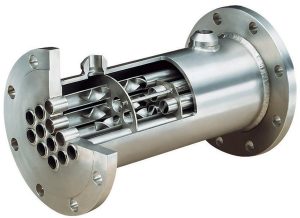
molybdenum and nickel alloys due to their high chemical resistance against strong acids and other reducing agents such as hydrochloric acid, sulfuric acid, hydrogen chloride and phosphoric acid; Used in pumps and valves, pressure vessels, heat exchangers, gaskets and piping products.
Chemical compounds for this type of alloys such as B-2 alloy have molybdenum concentration between 29-30% and nickel concentration between 66-74%.
Chrome and nickel alloy
Chrome and nickel alloy because of its high corrosion resistance, high heat resistance and electrical resistance; It has a lot of value.
For example, the NiCr 70/30 alloy known as Ni70Cr30, Nikrothal 70, Resistohm 70 and X30H70 has an electrical resistance
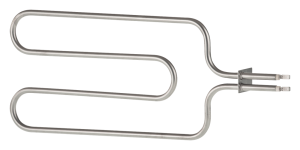
1.18 microohm/m and the melting point is 1380 degrees Celsius, therefore this type of alloy is used in the production of heating elements such as in toasters and other heaters with high electrical resistance.
Nickel rolling
Bullet nickel
Nickel plate
Nickel sheet
Application of nickel
-
- mintage
- Production of chemical tools in special alloys
- Machine parts
- Used to cover nickel chrome, for the food industry
- Repair parts and electrical forming due to the strength and hardness of this element
- Ship propeller and chemical shipping barrels
- Space and missile component
- Piping related to chemical industries
- Manufacture of stainless steel (about 65% of nickel used in the world) and alloy steel
- Application as a super alloy (12% of nickel used)
- Rechargeable batteries
- Catalyst for hydrogenation of vegetable oils
- Sheet and casting products
- Anti-theft door, armored sheets and anti-theft safes
- In the manufacture of special alloys, such as alnico, which is used in the manufacture of magnets
- Plants used in chemical laboratories
- Smart wires or memory alloys used in robots
- Kitchen appliances
- Chrome plating industries
- Automotive industries, trains and tankers
- Steel production industries, for the production of kitchen utensils, dishwashers and washing machines
- Construction and electronic industries
- Use of nickel and iron alloy in lead frames
- The use of copper, nickel and tin alloys in springs, terminals and paper clips
- Electric and nuclear energy
- drilling
**** What are the effects of nickel on the environment?
Nickel will be released into the air by power plants and landfills. This metal can be transferred to the ground after it reacts with raindrops. It takes a long time for nickel in the air to disappear. This metal can also be found in the part of the sewage flow that enters the surface water. A larger part of all nickel compounds that are released into the environment will be transferred to sediments or soil particles. Therefore, they become immobile.
However, in acidic soils, nickel is more mobile and will often find its way into groundwater. Not much information is available regarding the effects of nickel on non-living organisms. But we know that the high concentration of this substance can damage plants and reduce the growth of algae in water. Microorganisms can also face a reduction in growth due to the presence of nickel. For animals, nickel is also an essential nutrient, but in small amounts. For animals, nickel is also an essential nutrient, but in small amounts.
What is causing allergy in different people by nickel?
The most common disease of people who are in contact with nickel is a skin rash called contact dermatitis. This disease can be caused by direct handling of objects containing nickel, which is common in most families. Coins, plumbing fixtures, certain shampoos and detergents, pigments, and jewelry can contain small amounts of nickel that can be absorbed through the skin. Over time, direct skin contact with these objects may cause a person to become sensitive to the metal and experience an allergic reaction to nickel. For example, wearing earrings made of metal containing nickel can sensitize a person to the element.
Scientists believe that the nickel in jewelry dissolves in the sweat absorbed by the skin. This metal may then bind with one of the body’s natural proteins. This nickel-protein complex may not be recognized by the immune system, and this may signal the body’s defense mechanisms to react to the complex as if it were an invading antigen.
The skin rash that occurs at the place of contact of this metal with the body will be one of the most common results of this reaction. In more severe cases, asthma attacks have been reported. When a person becomes sensitive to this substance, even nickel that is ingested through food may cause allergic symptoms. For this reason, allergists recommend that those with a severe nickel allergy reduce the amount of nickel in their diet by avoiding certain foods shown in the box below.
Nickel rolling
Types of nickel rolling
What is the price of nickel?
Properties of nickel for the body